
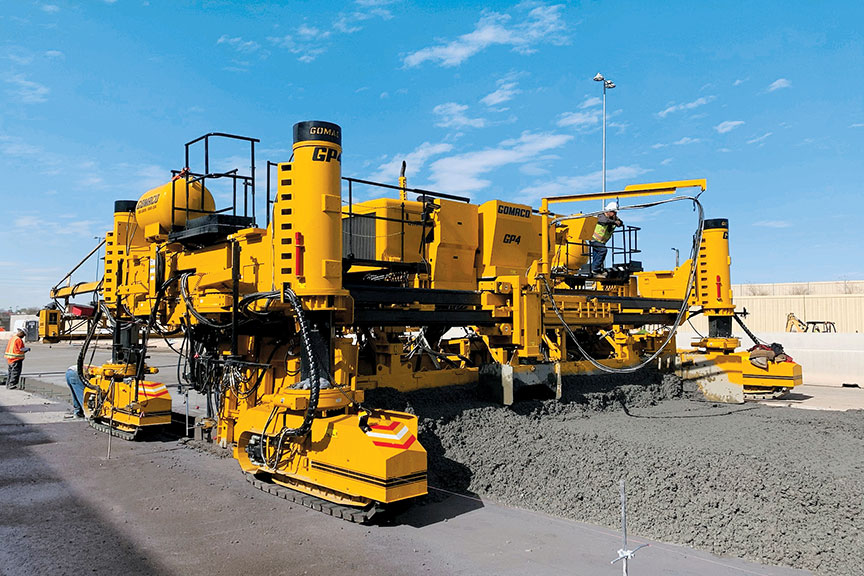
A Closer Look at Slipform Pavers
Civil construction has had a handful of machines that actually changed the industry, and the slipform paver is one of them. Before slipform technology became standard, concrete kerbing and pavement were formed using conventional formwork. And that was a labour-intensive, time-consuming process that limited the speed and the geometric consistency of what could be built.
The slipform paver removed that constraint and has become the standard tool on major concrete paving projects across the GCC. A backhoe loader handling material positioning and site preparation ahead of the paver is a common sight on these projects, and the coordination between ground preparation and paver operation is tighter than it might look.
How slipform paving actually works
The slipform paver moves continuously along a predetermined line. It receives wet concrete from a feed system at the front, consolidates and shapes it, and returns a fully formed concrete structure at the rear. The whole process happens in a single pass at a controlled travel speed, which is key.
Vibrators inside pavers consolidate the concrete as it passes through the machine, removing air voids and making sure the material fills the mould profile. You also need to make sure that the extrusion pressure and vibration frequency are adjusted according to the concrete mix.
Modern slipform pavers can now also monitor concrete consistency and vibrator performance. The operator sets the parameters, but the machine makes the adjustments that keep the output within specification.
On a project in Dubai during the summer, where concrete temperature varies between early-morning pours and midday deliveries, this automatic management maintains output consistency throughout the full shift.
Concrete supply determines everything
A paver can only move as fast as the concrete arrives, and any interruption in supply forces the machine to stop, which creates a cold joint in the poured structure that affects both structural integrity and surface finish.
Delivery intervals need to be tight enough that the paver’s hopper never runs low, but not so frequent that concrete is sitting in trucks longer than its workability window allows. On large projects where the paver is running long daily shifts, that coordination needs to be actively managed throughout the day.
A highway contractor paving a service road on the outskirts of Abu Dhabi found that their paving productivity was consistently below the target rate despite the paver operating correctly. The issue traced back to the batching plant being sized for average rather than peak demand during continuous paving runs.
During periods when the paver was running at full travel speed, the plant couldn’t batch quickly enough to keep the delivery trucks loaded without gaps appearing in the supply. Increasing the batching plant output resolved this gap, and the paving distance achieved in the following weeks consistently met the target.
Good paving needs good ground
Slipform paving produces a finished concrete structure in a single pass, and the subbase it’s poured onto needs to be at the correct level and properly compacted first. Any deviation in the subbase level that exceeds the grade correction range produces an issue that cannot be corrected without redoing it all.
That’s why the ground preparation phase immediately before paving is critical. The subbase must be finely graded to the required tolerances, and any external material must be cleared.
On projects where the preparation work is being done with a backhoe loader for sale and already on site as part of the project fleet, having that machine available and correctly positioned ahead of the paving run is a requirement that needs to be built into your schedule from day one.
Surface finishing and curing make the final look
You can get a formed concrete surface, but the finishing and curing work determine the final surface quality. Texturing needs to be applied within a narrow window. Go in too early, and the surface will be damaged. But wait too long, and the concrete will have hardened beyond the point where texturing is effective.
Curing follows texturing and must cover the full surface area uniformly before the concrete dries. On a hot, sunny day in the UAE, that window is short, and a flooring saw used for joint cutting in the cured concrete is equally time-sensitive.
Joints need to be cut before the concrete develops enough strength to crack randomly, but not so early that the saw tears the aggregate out of the surface rather than cutting cleanly through it.
The best flooring saw for this is one with a blade depth adjustment precise enough to hit the required joint depth without overcutting. Each of these post-paving steps has a timing requirement that the site must account for, and the team needs to be ready.
Where slipform paving is heading
The direction of development in slipform paver technology is towards automation. We’re talking automatic concrete monitoring and real-time geometric verification. New tech is also moving towards integration with project management systems that can track productivity and concrete consumption against your specific targets, making the process unique to your work.
And for contractors and project owners evaluating a slip form paver for sale as an investment, these development directions are worth factoring in.
The slipform paver has already changed what concrete paving can achieve at scale. The next generation of the technology is narrowing the gap between what’s designed and what gets built even further.